What You Can Learn From Military Principles by Virender Kapoor
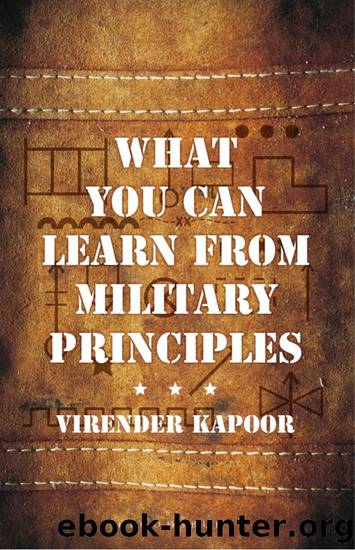
Author:Virender Kapoor
Language: eng
Format: epub
ISBN: 9789386349569
Publisher: Bloomsbury Publishing
Published: 2019-12-19T00:00:00+00:00
Changing Scenario-different shades different times
Deception and surprise have been in existence from the beginning of the history of warfare. Surprise attacks and Guiles were practiced by biblical warriors and kings. From ancient Persia, Greece and Rome, through double World Wars and the first decade of the 21st Century, nations and non-state actors have conducted Surprise and Deception and have fallen victim to them.
Before the twentieth century, soldiers fought battles mostly on foot or on horseback. Speed and ability to maneuver was limited by the speed of foot marching infantry. The horses determined the highest attainable speed in a battle. In such battlefields, the element of surprise was an important winning parameter. Commanders at all levels tried to outwit their adversaries during all the major wars of the 19th century. Deceit, deception and surprise were therefore used in all major military campaigns during the Napoleonic wars (1803-1815), the American Civil war (1861 â 1865) and the Franco Prussian (1870 â 1871) war.
The speed and lethality in warfare took a quantum leap during the first and the second world wars. This was primarily because of mechanical transport, tanks, aircraft, ships and tremendous firepower of guns and small arms. In such a scenario, surprise and deception had a bigger impact on tactics and strategy as the new generation of weaponry compressed the reaction time for the belligerent commanders. During the two major wars, armed forces in most military operations including air and naval operations, employed deception and surprise to their advantage.
Cold war started between the Russians and the Americans immediately after the Second World War. Nuclear weapons and the space-based ballistic missiles brought about a marked change in the weapon systems. The lethality and destructive power of nuclear weapons was unimaginable which brought a paradigm shift in strategic thinking. In fact, cold war was literally a game of cat and mouse where both Russians and Americans were âpreparing all the time not to get surprised by the other.â
Space based missile systems had an intercontinental range and time of flight measured in minutes. This compressed the reaction time tremendously. Space based monitoring systems and sensors could track enemy missile attack in seconds. Integrating all these together creates a formidable system that makes the operational scenario very complex. In such a scenario, space-based sensor systems are essential to prevent strategic surprise. Both the adversaries need to have such systems in place. Today each nation state needs to maintain âtechnological parityâ in order to remain at par with others.
Any weapon system that can escape scrutiny from space will be the ultimate winner. It is in a way a âTechnology Race.â
Strategic advantage can be gained by developing and acquiring a new family of weapon systems without the adversary knowing about it. This in effect is a technological surprise. Such revolutionary or breakthrough systems are not easy to come by and extremely difficult to hide from the enemy. In the past, radio, radars, rockets, space based missiles and atom bombs were the game changers. In practice, it is
Download
This site does not store any files on its server. We only index and link to content provided by other sites. Please contact the content providers to delete copyright contents if any and email us, we'll remove relevant links or contents immediately.
The Brazilian Economy since the Great Financial Crisis of 20072008 by Philip Arestis Carolina Troncoso Baltar & Daniela Magalhães Prates(361017)
International Integration of the Brazilian Economy by Elias C. Grivoyannis(111585)
The Art of Coaching by Elena Aguilar(53640)
Flexible Working by Dale Gemma;(23360)
How to Stop Living Paycheck to Paycheck by Avery Breyer(19834)
Thinking, Fast and Slow by Kahneman Daniel(12526)
The Acquirer's Multiple: How the Billionaire Contrarians of Deep Value Beat the Market by Tobias Carlisle(12428)
The Radium Girls by Kate Moore(12177)
The Art of Thinking Clearly by Rolf Dobelli(10715)
Hit Refresh by Satya Nadella(9255)
The Compound Effect by Darren Hardy(9146)
Tools of Titans by Timothy Ferriss(8591)
Atomic Habits: Tiny Changes, Remarkable Results by James Clear(8517)
Turbulence by E. J. Noyes(8201)
A Court of Wings and Ruin by Sarah J. Maas(8107)
Change Your Questions, Change Your Life by Marilee Adams(7930)
Nudge - Improving Decisions about Health, Wealth, and Happiness by Thaler Sunstein(7850)
How to Be a Bawse: A Guide to Conquering Life by Lilly Singh(7613)
Win Bigly by Scott Adams(7344)
